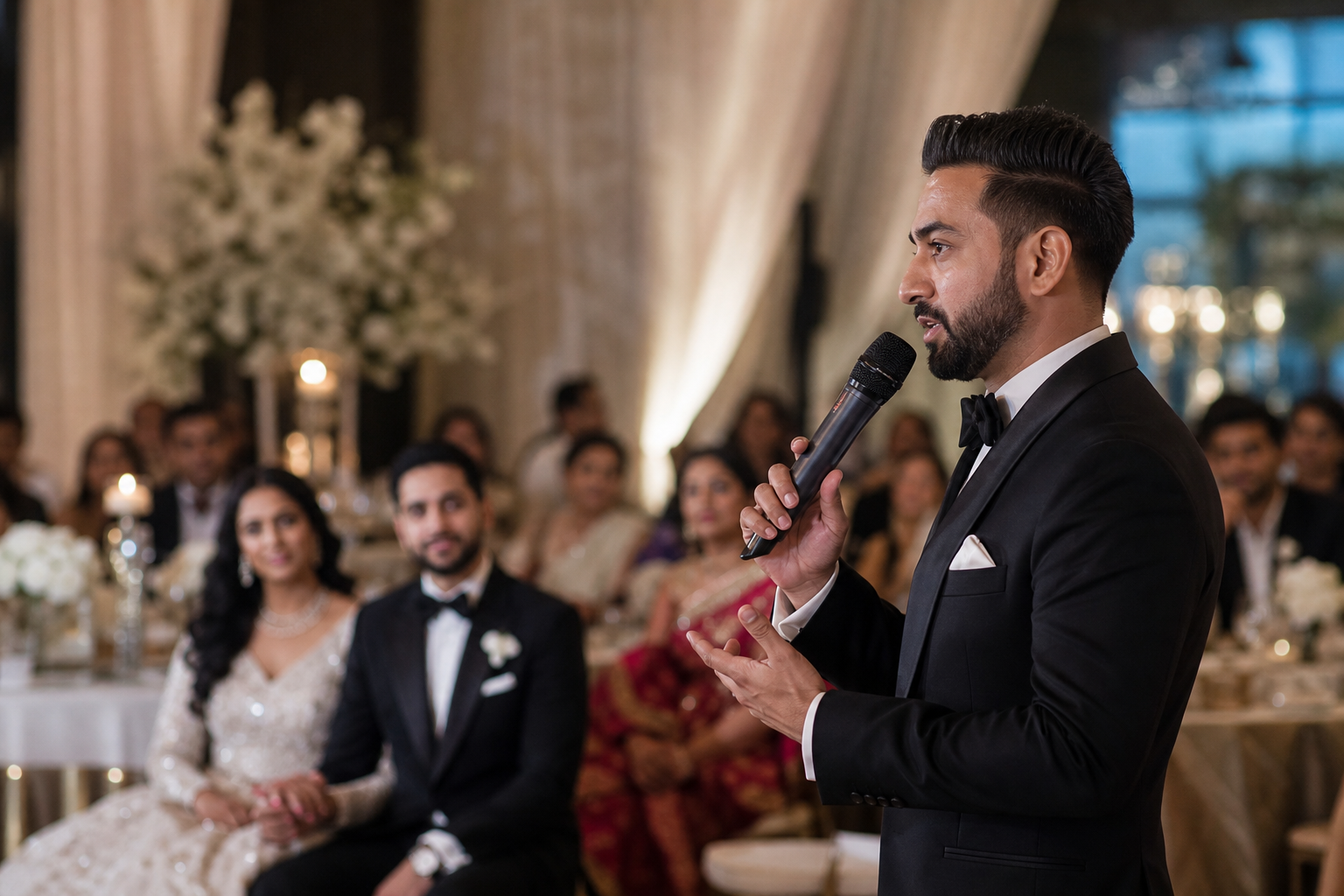
Wedding MC timeline planning mistakes to avoid
Avoid common wedding MC timeline planning mistakes with vendor-ready checks, exact cue wording, and a one-page cue sheet to share 7 to 10 days before the event.
Wedding MC timeline planning mistakes to avoid
Wedding MC timeline planning is the moment when all vendor work becomes a single sequence. For South Asian and multicultural weddings in the GTA, a clear, vendor-ready MC timeline prevents missed cues, mismatched music, and visual moments that fail to photograph well. This article names the most common mistakes couples make when briefing the MC, explains exactly how each one breaks the day, and gives precise fixes, vendor questions, and a copyable cue-sheet template you can send to your team.
Why a precise MC timeline matters for your wedding day
The MC timeline is the map the DJ, photographer, videographer, venue staff, and any live performers follow. When it is specific, everyone knows who starts what and when the room must be camera ready. A well-timed MC helps manage guest movement, preserves photo opportunities like golden-hour portraits, and protects planned effects such as cold sparklers or dry ice. For practical samples and timing benchmarks, see the day-of schedule guidance from Bridebook and the step-by-step timeline method at Pix Wedding.
Where you have integrated entertainment and production, for example DJ, MC, special effects, and videography coordinated by a single team, a precise MC timeline turns those elements into cinematic moments instead of competing activity. If you plan significant staging, lighting, or live dhol accompaniment, include your entertainment partner early so staging and equipment needs are accounted for. You can review coordination approaches with local providers such as B-Town Entertainment for integration across music, effects, and visuals.
When to draft and when to lock the MC timeline
Work backward from your ceremony start time or your chosen golden-hour for photos, not vendor arrival times. Planning guides recommend preparing a draft well before the event and circulating a locked version to vendors near the date. In practice, prepare a draft 6 to 8 weeks before the wedding and send a final, locked timeline to all vendors 7 to 10 days before the event. Keep a printed one-page cue sheet on-site for the MC and the venue manager so it acts as the single source of truth on the day. For a month-by-month workflow, consult the timeline recommendations at Wedkit.
Seven common MC timeline mistakes, how they break the day, and exact fixes
Mistake 1: building the timeline around vendor convenience instead of the ceremony time
The error: Starting the schedule from when vendors can set up or arrive often shifts the ceremony later or compresses photography and golden-hour windows.
Why it breaks things: Guests are delayed, photos are rushed, and entrance moments feel hurried.
Fix: Work backward from the ceremony or planned sunset time for portraits. Confirm the ceremony start time in writing, then block fixed event points such as baraat arrival, ceremony length, group photos, and the reception entrance. Question to ask: "Is the timeline built backward from the ceremony time and golden-hour window?" Expect a yes or a proposed adjustment with minutes.
Mistake 2: leaving cultural moments unallocated or underscheduled
The error: Treating baraat, roka, jaggo, blessings, or multi-ritual ceremonies as single-line items rather than discrete timed entries.
Why it breaks things: Cultural moments overrun, other vendors are unprepared, and recorded highlights lose structure.
Fix: Assign clear durations to each cultural moment and add a 10 to 15 minute buffer for activities that traditionally run long. Example allocations: baraat arrival 15 to 30 minutes, roka blessing 10 to 15 minutes, jaggo or haveli entry 20 minutes. Question to ask: "How many minutes are scheduled for each cultural moment and what is the buffer plan if one runs long?"
Mistake 3: not assigning timeline ownership on the day
The error: No single person is empowered to confirm last-minute edits, so vendors respond to different instructions.
Why it breaks things: Conflicting cues lead to skipped announcements and botched entrances.
Fix: Name one timeline owner in writing, typically the lead MC or the day-of coordinator. Document the communication chain: timeline owner, venue contact, DJ lead, photographer lead, and videographer lead. Question to ask: "Who is the day-of timeline owner and who will make the final call on last-minute changes?" The owner should have the printed timeline and direct line to every vendor.
Mistake 4: failing to include realistic travel and setup buffers for GTA venues
The error: Underestimating load-in, parking, elevator wait times, or travel between separate ceremony and reception sites in the Greater Toronto Area.
Why it breaks things: Late vendor arrival compresses setup and can delay the start of important moments.
Fix: Add explicit buffer windows. For large productions, plan vendor arrival 90 minutes before guest access, and for simple DJ setups plan 60 minutes. If you have separate venues, add 30 to 60 minutes travel time depending on distance and traffic. Confirm load-in requirements with the venue and write them into vendor call times. Question to ask: "What is your required on-site setup time and what contingency do you need for local traffic or load-in constraints?"
Mistake 5: vague entrance cues and mismatched music wording
The error: Using ambiguous directions such as "play entrance music" without agreed cue language or track timing.
Why it breaks things: The DJ starts at the wrong tempo, the MC speaks over a beat drop, or the live dhol and tracks do not line up.
Fix: Provide exact cue wording and timestamped instructions. Use short, actionable phrases that both MC and DJ copy into their cue sheet. Examples: "Grand entrance: 00:00 start, DJ fade in to chorus at 00:12, MC waits until chorus at 00:15 before announcing." For a baraat: "Baraat arrival: DJ hold at loop 1 until dhol band signals, then full track at cue 'dhol-in'." Question to ask: "Do these cue wordings match your equipment prompts and can we run a 30-second sound check of the entrance track?"
Mistake 6: sending no final timeline to vendors or sending it too late
The error: Distributing the timeline hours before the event or not distributing it at all.
Why it breaks things: Vendors have no time to coordinate equipment, set playlists, or confirm special effects and transitions.
Fix: Share a draft 6 to 8 weeks out for feedback, then lock and distribute the final version 7 to 10 days before the wedding. On the day, provide a printed one-page cue sheet to the MC, venue manager, and DJ. Question to ask: "Did you receive the locked timeline 7 to 10 days ago and do you have a printed cue sheet for the day?" If the answer is no, request an immediate review meeting.
Mistake 7: ignoring venue rules or not confirming special-effects permissions
The error: Assuming cold sparklers, dry ice, or indoor pyrotechnics are automatically allowed.
Why it breaks things: Effects are cancelled at the last minute, or worse, they trigger safety responses that interrupt the event.
Fix: Confirm the venue's written policy on each effect, and request permission in writing. Coordinate timing and safety procedures with the venue and your effects operator. If you intend to use dry ice or cold sparklers, include the start and end times for effects on the timeline and name who will supervise them. Question to ask: "Is written approval in place for these effects and who is the onsite safety contact?"
Vendor handoffs: what the MC needs from the DJ, photographer, videographer and venue

Successful handoffs remove ambiguity. Provide the MC with this checklist of fields so they can operate as the timeline owner.
- Confirmed ceremony start time and expected end time, with contact who will announce delays
- Entrance playlist names, exact track timestamps for cue points, and whether live performers will join the track
- Photographer golden-hour window plus list of required group photos and expected locations
- Videographer note on when to capture effects such as cold sparklers and dry ice, and preferred camera angles
- Mic details: primary wireless mic model, backup wired mic, and who handles mic handoff for speeches
- Special effects permissions and start times, and the onsite safety contact name and phone number
- Direct communication channel for the day: vendor WhatsApp group or radio channel contact list
Also include file and format notes for music and cues. For example, ask the DJ whether they prefer MP3, WAV, or an exported cue file and confirm who will supply entrance tracks. Where possible, add vendor contact names and mobile numbers on the one-page cue sheet so the MC can resolve problems immediately.
Vendor-ready MC cue sheet and timeline template (fields to copy)
Use this one-page structure as the printed cue sheet you distribute on the day. Keep it concise and copyable into email or messaging tools.
- Event name, venue, ceremony time, reception start time
- Timeline owner name and mobile
- Vendor list with direct contacts: DJ, lead MC, photographer, videographer, live dhol, effects operator, venue manager
- Key timeline blocks with exact times and cues. Example block for an evening reception with Punjabi and Bollywood moments:
- 5:00 PM, Guests seated
- 5:15 PM, Baraat arrival, dhol lead cue "dhol-in"
- 5:30 PM, Ceremony begins, processional music track: "Track A" start 00:00
- 6:00 PM, Ceremony ends, 10 minute group photos at altar
- 6:15 PM, Cocktail photos and guest transition, DJ ambient set
- 7:30 PM, Reception doors open
- 7:45 PM, Grand entrance: DJ intro build, MC wait for chorus at 00:15 then announce couple
- 8:00 PM, Speeches, mic to be passed to family speaker 1
- 8:20 PM, First dance, dry ice on at intro 00:03, cold sparklers if approved at chorus
Keep cue wording short and consistent so the DJ and MC can paste it into their consoles or show it on a tablet in real time.
Decision checklist and exact questions to ask your MC, DJ and venue
Run this checklist in a short call with each vendor. These single-sentence questions get fast yes or no answers.
- "Is the timeline built backward from the ceremony or golden hour?"
- "Do you have the final locked timeline and a printed one-page cue sheet?"
- "Who is the day-of timeline owner and how will you be reached?"
- "Can you confirm written permission for cold sparklers or dry ice and name the venue safety contact?"
- "Do entrance cue wordings exactly match on the MC and DJ cue sheets?"
Real objections and how to decide: flexibility, cost and MC control

Couples sometimes want a flexible timeline or prefer vendors to call their own cues. Decide objectively. If flexibility matters more than photos or specific entrance effects, accept larger buffers and fewer strict cues. If visuals and reel-ready moments are your priority, insist on a locked cue sheet and a named timeline owner. Discuss trade-offs with your planner or lead entertainment partner so that expectations are recorded and agreed.
Final steps: what to send, who to call 48 hours before the wedding, and what to keep printed
- Send the locked PDF timeline to all vendors 7 to 10 days before the event and ask for confirmations in writing
- Call or message the lead vendor, the venue manager, and the photographer 48 hours before the wedding to confirm arrival and setup windows
- Bring printed copies: one for the MC, one for the venue manager, one for the DJ, and one spare for the day-of coordinator
- Keep a digital copy in the vendor WhatsApp group for rapid distribution if something changes
Drafting and locking your MC timeline in this way follows the standard planning cadence many Canadian couples use. For timing benchmarks and sample layouts consult the planning resources at Pix Wedding and Bridebook.
Frequently asked questions
When should I lock the final MC timeline with vendors?
Lock your final timeline 7 to 10 days before the wedding. Circulate an early draft 6 to 8 weeks out to capture vendor constraints and then confirm the locked version close to the date so everyone has time to prepare, following common planning practice.
What exactly should be included on a vendor-ready MC cue sheet?
Your cue sheet should include the ceremony and reception start times, timeline owner contact, vendor contacts, entrance track names and timestamps, allocated minutes for cultural moments, special-effects start times, microphone handoff notes, and a short emergency plan with the venue contact.
Who should have final authority to change the timeline on the wedding day?
The timeline owner should have final authority. This is often the lead MC or the day-of coordinator. The owner must be empowered in writing to make calls and should be reachable by phone and in person throughout the event.
How do I confirm whether my venue allows cold sparklers or dry ice effects?
Ask the venue manager for written confirmation. Provide the effects operator name and planned timings, and request the venue safety contact and any required insurance or operating procedures before you include the effect in the locked timeline.
How much buffer time is reasonable between ceremony and reception in the GTA?
Allow at least 30 minutes for guest transition when both events are onsite and 45 to 60 minutes when travel or significant setup changes are required. For larger production load-ins, plan vendor arrival 60 to 90 minutes ahead of guest access.
Ready to lock your timeline
If you want MC and timeline coordination that covers DJ, effects, dhol, and on-site production, contact B-Town Entertainment to request a quote or schedule a short planning call. They can provide a vendor-ready cue sheet tailored to your ceremony and visual priorities.